
Remember Chichen Itza


A BIG part of the culture in the Yucatan Peninsula is Maya. The people who live there today are direct descendants of what you may think of as the Lost Mayan Empire. You hear about Mayan ruins and pyramids, but you may not realize that the Maya people still live among the jungles and farmlands of the Yucatan even as I write this.

Most of them still incorporate traditional clothing, food, building techniques, art, language (YES! You can learn the speak Maya!) and religion into their daily lives.

In January, when my daughter and I went to Mexico, we visited the state of Yucatan where the famed ruins of Chichen Itza are. Standing on the sacred grounds of the temple of Kukulkan is an experience that makes you pause, almost stop breathing, and try to take in the energy of the place and imagine what it was like to be there hundreds of years ago when life in the city was in full swing.


But one of the most humbling things about the site, is to stop and take time to connect with the local people who are there. Now. Today. Selling their art. Trying to feed their families.
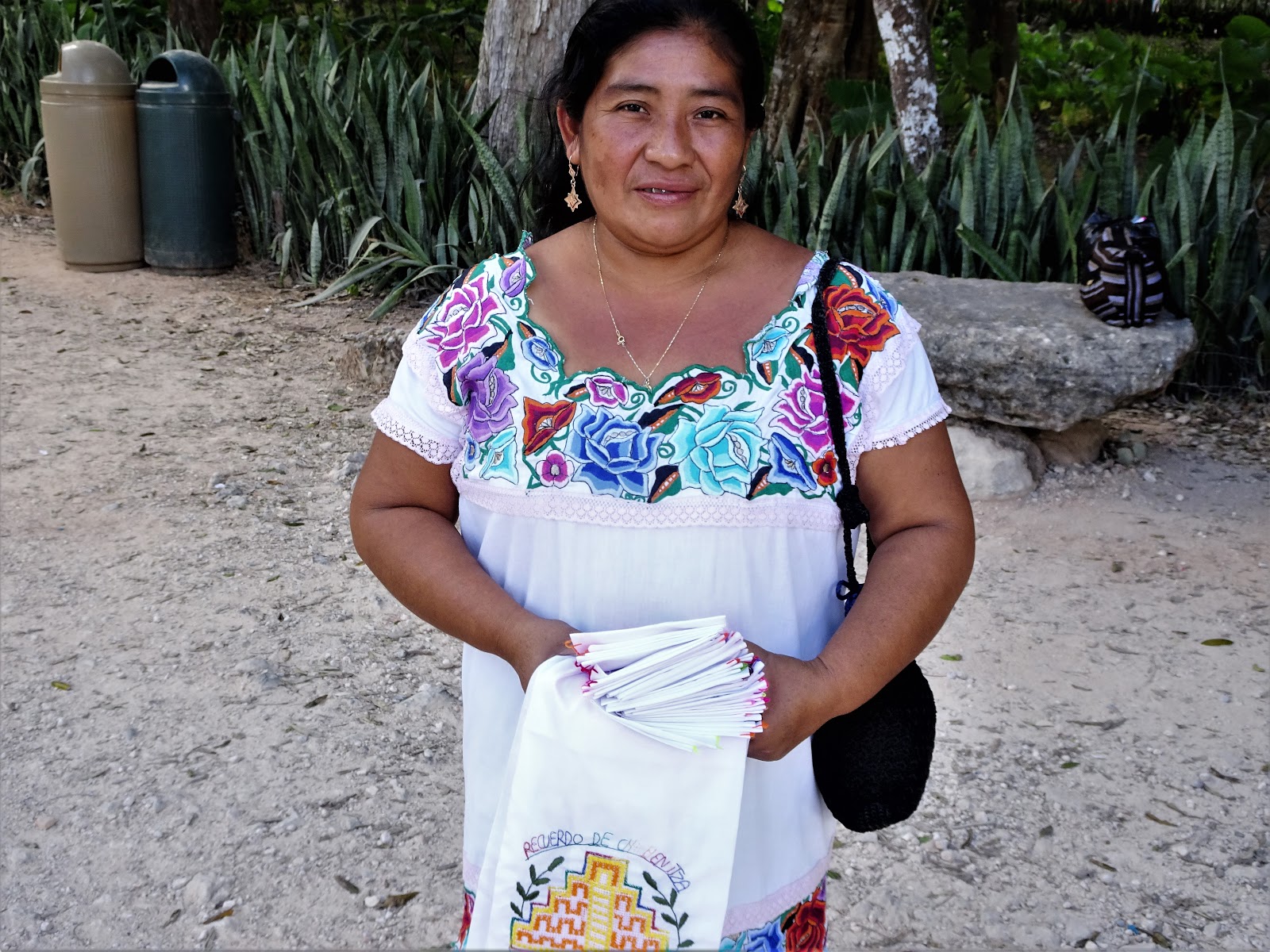

Working daily in the ruins of a city that IS their own.

How do you get your brain around that?

I bought this handkerchief hand embroidered by this little Maya lady. Her names is Isabella. She sells the things she makes among the ruins of a place where astrologers predicted the exact times comets would pass the earth thousands of years before the comets came, a place where people were sacrificed in times of great turmoil, where tribal wars bloodied the ground, and where immeasurable secrets were lost with the burning of all but two of the ancient books.

And here she stands, asking for a dollar for something she made.

And what does the embroidery say?

"Remember Chichen Itza"


Yu'um Bootik (God go with you -- in Maya)
laura


June 24- July 01, 2017 I am taking a small group back to Chichen Itza and to other sacred places on the Yucatan. We are going in search of the secrets of happiness.
For more information go to https://www.strangertruthtravel.com/happify-mexico-june2017


Comments

Popular posts from this blog

Why I Am Here: The Beauty in the Poor Places

I don't write about myself very often, but this time I just want to share a little bit. I want to tell you why I am here. I have been in Central America for five years now. I came on vacation and never went home. Something happened to me that is hard to explain. I walked streets I wasn't sure were safe. I went places I wasn't sure I would come back from. I got really far out of my comfort zone. And in the most unlikely places, I found life. Now I understand why Jesus ate with the prostitutes and drunkards. Why he went to the lost and the broken. They are actually cool people! You cannot imagine how amazing it was to hear their stories, to feel their pain and share their joy, to meet their families and get to know their names. I wish I could explain to you the beauty I see. I wish I could take the feeling that swells inside me and put it in your heart. I am without words, and so I try to convey in pictures the depth I see in their eyes the joy in the e...

Making Connections in Mexico

I spent some time in the little village of Leona Vicario, about an hour inland from Puerto Morelos on the Yucatan Peninsula. Quaint place. I bought a tamale from an old woman. and I bought fresh orange juice from a sweet old man. I stopped in at the tortilla factory and bought a small stack of still hot tortillas, right off the press. I watched a lady cut up chicken for her customers. She had a lovely smile. And I spent some time talking to two guys who worked at the fruit and veggie stand. The older man let me touch his Rosary and the younger practiced his English with me. I just love connections. Doing a happy dance, laura www.povertyprojectinternational.com

Death and Hope in Golondrina: A Displaced Family in Bocas Del Toro, Panama

Maria and her baby brother used to live next door along with the rest of the seven people in their family. They had a little house with running water and electricity, a privilege many do not have in this community. But several days ago all seven of them were asked to leave their home because they could not pay the rent. They stood outside my house, hearts broken, a few simple things in bags, and said they planned to live in the parking lot at the bank. There was a policeman there and a wide over hang on the building, so it was a good place to sleep. This is the house out behind my house in rural Panama. Both homes belong to a lovely older woman named Shirley. She is tall and dark with high cheekbones. She wears her silver hair in a bun and always dresses in skirts and she has the mostly lovely Jamaican yah-mon English. Shirley is a woman acquainted with sadness. She lost her soul-mate, the husband of her youth, when she was in her twenties and became a widow. She lost two mo...